
Somewheres...Anywheres
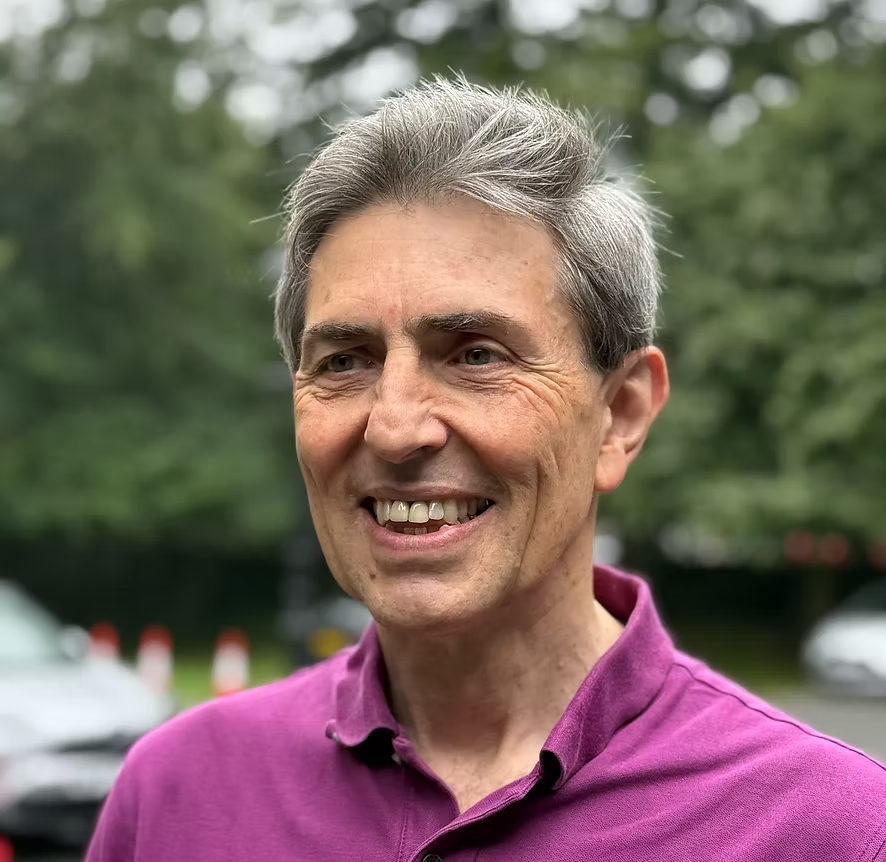

This sermon, part of the Cut Flower series on the decline of European Christianity, explores how the power of the Holy Spirit releases the life of Jesus into the world and offers a hopeful alternative to today’s divided society. Using David Goodhart’s distinction between “anywheres” and “somewheres,” +Tim reframes these groups positively as “seekers” (those shaped by mobility, education, and career) and “dwellers” (those rooted in place, relationships, and community). Rather than being in conflict, both are invited into God’s mission.
Drawing on Acts 1, the sermon highlights Jesus’ vision of a global movement: believers are called to be witnesses from their local context to the ends of the earth. This “Ephesian momentum” describes the spread of the kingdom of God through the Holy Spirit, bringing together diverse peoples and cultures. Whether people stay local or move globally, all can participate in this Spirit-led mission.
+Tim reflects on the history of Christianity in Europe, tracing its journey from early Jewish roots to Greek and Latin forms, through Christendom, the Reformation, and eventual secularization. European Christianity became “territorial,” assuming that the kingdom of God could be tied to geography, political power, and institutions. This model ultimately limited the church’s vitality.
In contrast, the modern missionary movement rediscovered a more dynamic and relational faith, though it was often misunderstood and entangled with colonialism. Through engagement with other cultures—especially in Africa—Christianity was reshaped and renewed. African Christianity, in particular, has grown rapidly by engaging deeply with local cultures and spiritual worldviews, leading to one of the most vibrant expressions of faith today.
The sermon emphasizes that Western Christianity now has much to learn from global Christianity. The anticipated visit of Kenyan Christians is presented as an opportunity for mutual learning and self-reflection. By seeing ourselves through the eyes of others, we may recognize weaknesses and rediscover a more authentic, Spirit-filled faith. As an African proverb suggests, “only the stranger can see the leak in your roof.”
A key theme is that mission is not about controlling territory or imposing beliefs, but about embodying the kingdom of God in different cultural contexts. Christianity spreads like a network—adaptable, relational, and rooted in local realities. The church does not equal the kingdom but serves as a witness to it.
The sermon also highlights the importance of engaging with “primal” spiritual longings—deep human desires for meaning, identity, and connection with God. True conversion involves the whole of life, not just personal belief, and requires demonstrating faith in lived, relational ways.
The conclusion calls for a renewed vision of mission that combines local commitment with global awareness. Practically, this includes serving local communities while also engaging across cultures. The hope is that through humility, openness, and the work of the Holy Spirit, Western Christianity can experience renewal and rediscover its place within the wider movement of world Christianity.


